
One of the best qualities of teachers is that we are always learning! 📖🏫
As such, education is always evolving and we are always learning about what is best practice to teach the little learners in front of us. On this note, the term ‘Science of Reading’ is something teachers are hearing a lot about lately.
So, what exactly is the Science of Reading? How is it helping students learn to read? And, perhaps most importantly, how does it impact the way we teach?
📚 The Science of Reading is a body of research from cognitive science, neuroscience, and education. It tells us how the brain learns to read, and more importantly, how we can support every student, including those who struggle.
✏️ At its core, the Science of Reading emphasizes structured literacy. This refers to explicit, systematic teaching that covers phonology, orthography, syntax, semantics, and morphology.
I’m a teacher with over 10 years experience in the classroom. I spent a significant amount of time teaching English abroad, particularly in South Korea. It was striking to me the way these students learnt about grammar and word structure in a way we didn’t focus on in Australia. So I was super excited when my school back home changed to the Science of Reading approach!
These were the main points that I loved teaching to my 5th and 6th grade students in Australia.
- 📖 Comprehension is more about knowing what the words on the page say. Having a structured approach to decoding enhances fluency.
- 🔍 Morphology (Greek and Latin roots, prefixes, and suffixes) helps students see patterns and make sense of complex vocabulary.
- 🌱 When students learn morphemes, they expand their word knowledge exponentially, which supports both reading comprehension and writing.
- 🎯Structured literacy ensures no student is left guessing about meaning. Reading skills are taught explicitly and practiced with intention.
- ✏️ Understanding morphology and morphemes significantly improve spelling. Students can use the roots and affixes they learn to approach writing confidently.
That’s why so many of my resources focus on morphology and morphemes. I love staying up-to-date with the SoR approach and creating activities that align with what the research tells us works.
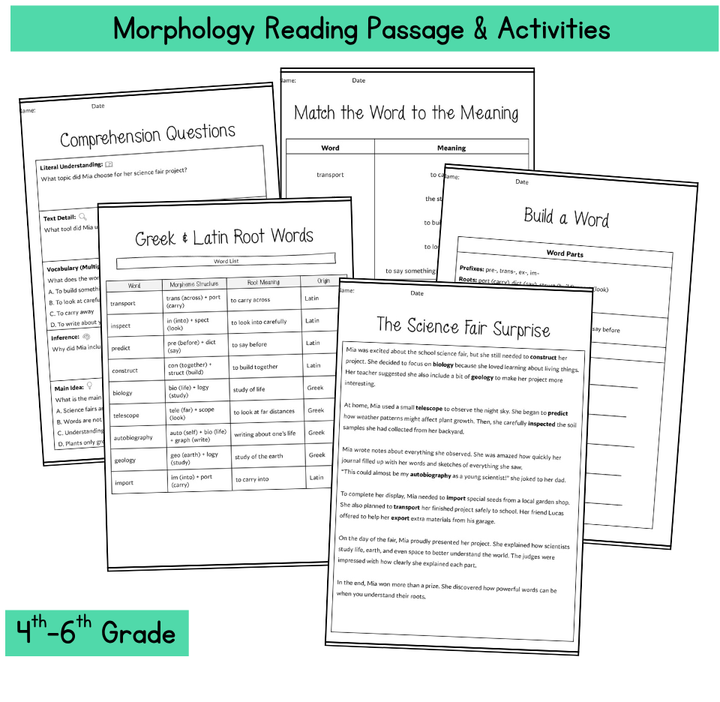
👉 If you’re looking for ready-to-use activities to support morphology instruction, you can check out my latest resources here:


Take a closer look at this product preview.


Check out my Teachers Pay Teachers store for more exciting morphology and literacy resources for upper elementary students.

Leave a Reply