
If you’ve been exploring the Science of Reading, you’ve probably come across Scarborough’s Reading Rope. Morphology is an important part of that rope for older students. When teachers provide engaging and fun morphology activities, students’ understanding words can flourish!
When students understand prefixes, suffixes, and Greek and Latin roots, they strengthen their:
- vocabulary
- language comprehension
- ability to decode unfamiliar words
This becomes especially important in upper primary and middle school, when students begin to encounter longer, more complex words.
The good news? Morphology can be surprisingly engaging.
When students realise that words are like puzzles that are made up of smaller parts they can break apart and understand, something changes.
- They stop guessing words.
- They start noticing patterns
- They feel much more confident tackling unfamiliar words

What Is Morphology?
Morphology is the study of word parts:
- prefixes (un-, re-)
- suffixes (-ful, -less)
- Greek and Latin roots (bio, port)
When students understand these parts, they can work out unfamiliar words more independently.
For example:
- preview = before + see
- careless = without care
- transport = carry across
Why Older Students Enjoy Morphology Activities
Morphology gives older students a challenge. It turns vocabulary into a puzzle to solve.
Students enjoy:
- breaking apart longer words
- spotting patterns between words
- building their own words
- acting like “word detectives”
Instead of feeling stuck when they see a difficult word, they have a strategy they can use.
Easy Ways to Make Morphology Activities Fun
Try:
- word-building activities
- word matrices
- mystery word challenges
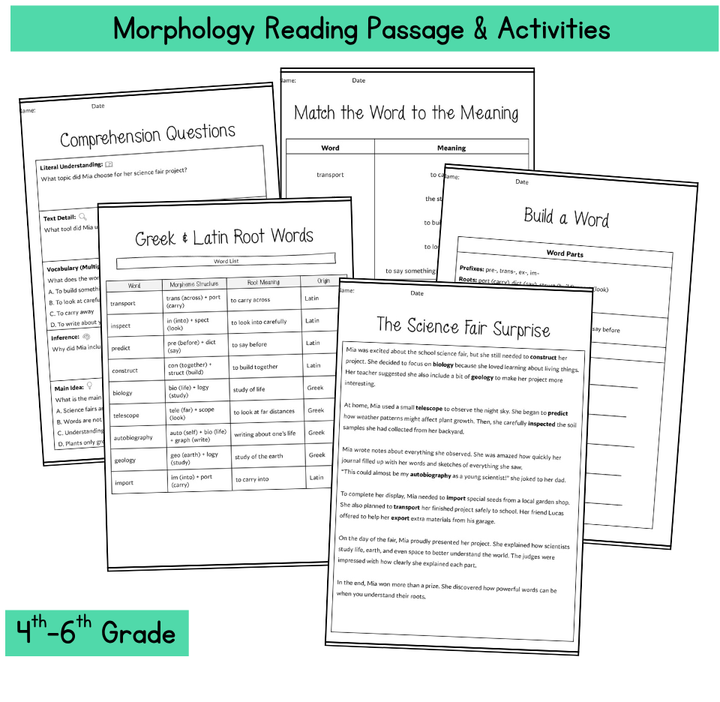
- short passages with morphology-rich words
- asking students to create their own words
Check out my workbook Morphology Quest: The Lost Language Adventure which takes students on a word-learning journey!
This is available on Kindle where it can printed and shipped to your door!

This resource is available on Teachers Pay Teachers as a PDF activity. Take a look at more details below!


Final Thoughts
Morphology doesn’t have to feel dry or difficult.
When students learn how words are built, they become more confident, independent readers, and often discover that word study can actually be fun.
Leave a Reply